How Long Does Insect Spray Last? Complete Duration Guide
Understanding how long insect sprays remain effective helps you time reapplications correctly and maintain consistent pest protection around your home.
Quick Answer
Most synthetic pyrethroid insect sprays last 60-120 days indoors and 14-45 days outdoors. Natural pyrethrins only last hours to a few days. Scientific research from the Journal of Exposure Science found that permethrin can persist indoors for at least 112 days at up to 89.6% of its initial concentration when protected from UV light and moisture.
In This Guide
When you spray for insects around your home, the immediate knockdown effect is just the beginning. The real value of most insect sprays lies in their residual protection: the ability to continue killing pests that cross treated surfaces days, weeks, or even months after application.
However, not all sprays are created equal. A natural pyrethrin spray might break down within hours, while a professional-grade bifenthrin treatment can remain effective for up to six months under ideal conditions. Understanding these differences helps you choose the right product for your situation and time your reapplications correctly.
This guide breaks down exactly how long different types of insect sprays last, what factors affect their longevity, and how to maximize the protection you get from each application. Whether you are dealing withroaches,ants,mosquitoes, or other pests, this information will help you maintain effective, long-lasting pest control.
Understanding Residual Protection
Insect sprays work through two primary mechanisms: contact kill and residual kill. Contact kill happens when spray directly hits an insect, while residual kill occurs when insects walk across surfaces treated with the spray, picking up lethal doses of insecticide through their legs and bodies.
The residual protection period refers to how long the active ingredient remains on surfaces in sufficient concentration to kill or repel insects. This depends on three key factors:
- Chemical stability: How quickly the active ingredient breaks down when exposed to air, light, and heat
- Surface binding: How well the spray adheres to and penetrates different surface types
- Concentration: The initial amount of active ingredient applied and the minimum needed to remain effective
Research published in the Journal of Exposure Science & Environmental Epidemiology found that permethrin applied indoors maintained up to 89.6% of its initial concentration after 112 days, demonstrating the remarkable persistence of modern synthetic pyrethroids in protected indoor environments.
How Long Each Active Ingredient Lasts
Different active ingredients have vastly different persistence times. The table below shows typical duration ranges for common insecticide classes. Actual results vary based on environmental conditions and application method.
| Active Ingredient | Indoor Duration | Outdoor Duration | Common Target Pests |
|---|---|---|---|
| Permethrin | 90-120 days | 30-45 days | Mosquitoes, flies, roaches, ants |
| Deltamethrin | 60-90 days | 14-30 days | Roaches, ants, bed bugs, spiders |
| Cypermethrin | 60-90 days | 21-42 days | General crawling insects |
| Bifenthrin | 90-180 days | 60-90 days | Ants, termites, mosquitoes |
| Lambda-cyhalothrin | 60-90 days | 30-60 days | Roaches, ants, spiders, wasps |
| Imidacloprid | 90-120 days | 45-90 days | Roaches, ants, termites |
| Fipronil | 90-180 days | 30-90 days | Roaches, ants, termites, fleas |
| Pyrethrins (natural) | 1-7 days | Hours to 1 day | Flying insects, contact kill |
Synthetic Pyrethroids (Longest Lasting)
Synthetic pyrethroids like permethrin, deltamethrin, and bifenthrin are engineered for stability and longevity. They bind tightly to surfaces and resist breakdown from environmental factors better than natural alternatives. Bifenthrin, in particular, can provide protection for up to 6 months indoors under ideal conditions.
Neonicotinoids (Long Lasting, Systemic)
Imidacloprid and other neonicotinoids offer 90-120 days of residual protection. They work differently from pyrethroids, targeting the insect nervous system through a unique pathway. This makes them excellent for rotation programs to prevent resistance development.
Natural Pyrethrins (Shortest Lasting)
Natural pyrethrins derived from chrysanthemum flowers provide excellent immediate knockdown but break down rapidly when exposed to light and air. Outdoor applications may lose effectiveness within hours, while indoor use in low-light areas might last up to a week. These are best used for immediate contact kill rather than residual protection.
Indoor vs Outdoor: Why the Difference?
You will notice from the table above that indoor durations are consistently 2-4 times longer than outdoor durations for the same active ingredient. This dramatic difference comes down to environmental exposure.
Indoor Advantages
- No UV exposure: Sunlight is the primary destroyer of pyrethroids
- No rain washoff: Residues stay in place indefinitely
- Stable temperature: Less thermal breakdown
- Lower humidity: Reduces hydrolysis reactions
- Protected surfaces: Less physical disturbance
Outdoor Challenges
- UV degradation: Can reduce effectiveness by 50-80%
- Rain and irrigation: Physically removes residues
- Temperature swings: Accelerate chemical breakdown
- Wind and dust: Cover or remove treated surfaces
- Microbial activity: Soil microbes break down chemicals
This is why professional pest control operators often recommend more frequent outdoor barrier treatments (monthly) compared to indoor treatments (quarterly). The University of Wisconsin research notes that insecticides can begin breaking down immediately upon mixing and application, with outdoor conditions dramatically accelerating this process.
Environmental Factors That Affect Spray Duration
Even within indoor or outdoor categories, several factors can significantly extend or shorten how long your insect spray remains effective:
Direct Sunlight
High ImpactUV rays break down pyrethroids 50-80% faster
Rain/Moisture
High ImpactWashes away residues, especially on non-porous surfaces
High Temperature
Medium ImpactSpeeds evaporation and chemical breakdown
Porous Surfaces
Positive ImpactAbsorbs spray, extending protection up to 2x
The UV Factor
Ultraviolet light is the single biggest factor affecting spray longevity. Pyrethroids are photolabile, meaning UV rays break their molecular bonds and render them ineffective. A spray applied in direct sunlight can lose 50% of its potency within 24 hours, while the same spray in a dark basement might remain effective for months.
This is why you should apply outdoor sprays in the early morning or late evening and focus on shaded areas like under eaves, behind shutters, and along foundation walls that receive less direct sun exposure.
How Surface Type Affects Duration
The surface you spray on dramatically impacts how long the treatment lasts. This comes down to absorption and binding properties:
| Surface Type | Duration Modifier | Notes |
|---|---|---|
| Untreated wood | +50-100% | Absorbs spray deep into grain, excellent retention |
| Concrete/masonry | +25-50% | Porous surface absorbs well, good for foundations |
| Carpet/fabric | +25-50% | Fibers trap and hold insecticide particles |
| Painted surfaces | Baseline | Standard reference for label durations |
| Metal | -25% | Non-porous, spray sits on surface |
| Glass/tile | -50% | Very non-porous, easily cleaned off |
| Vinyl/plastic | -25-50% | Non-porous, some plasticizers may interact |
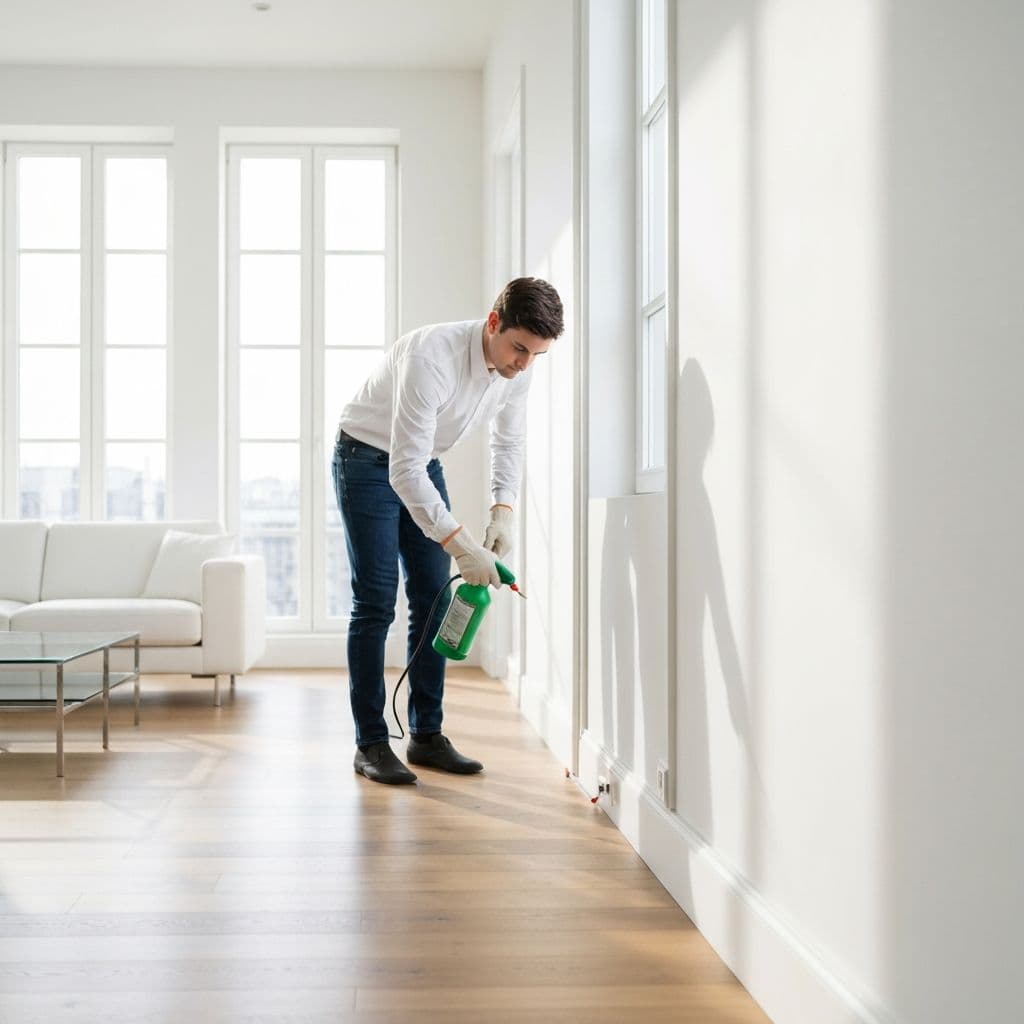
This is why baseboards, door frames, and window sills (often unpainted or minimally finished wood) provide excellent treatment surfaces, while spraying tile floors or glass surfaces yields much shorter protection periods.
Tips for Maximizing Spray Effectiveness
Follow these expert recommendations to get the longest possible protection from your insect spray applications:
Apply to clean, dry surfaces
Dust, grease, and moisture create barriers that prevent spray from binding to surfaces. Clean treatment areas first and allow them to dry completely before application.
Avoid cleaning treated areas
Wait at least 48 hours before any cleaning. For long-term protection, avoid mopping or wiping treated baseboards and perimeters for 2-4 weeks after application.
Time outdoor applications wisely
Apply in early morning or evening to avoid UV degradation during drying. Check weather forecasts and avoid application if rain is expected within 24-48 hours.
Focus on protected areas
Concentrate outdoor treatments on shaded areas: under eaves, behind shutters, along covered porches, and in foundation crevices. These areas retain protection longer.
Use appropriate coverage rates
Follow label instructions for coverage rates. Under-applying reduces both immediate effectiveness and residual duration. More is not always better either, as it wastes product without improving results.
When to Reapply: Practical Schedule
Rather than waiting until you see pests again, proactive reapplication maintains continuous protection. Here are recommended schedules based on typical product performance:
| Treatment Location | Standard Schedule | Active Infestation |
|---|---|---|
| Indoor perimeter | Every 2-3 months | Monthly until resolved |
| Outdoor foundation | Every 30-45 days | Every 2-3 weeks |
| Yard/lawn treatment | Every 4-6 weeks | Every 2-3 weeks |
| After heavy rain | Reapply outdoor treatments within 24-48 hours | |
Signs You Need to Reapply Sooner
- Seeing live pests in previously treated areas
- Heavy cleaning or renovation disturbed treated surfaces
- Significant rainfall or flooding near treated outdoor areas
- Visible residue has worn away from treated surfaces
Natural vs Synthetic: Duration Comparison
If you are choosing betweennatural and chemical insect killers, duration is a major consideration:
Natural/Organic Sprays
- Pyrethrins: Hours to 7 days
- Essential oils: 1-4 hours typically
- Neem oil: 1-3 days
- Diatomaceous earth: Indefinite when dry
Best for: Immediate knockdown, sensitive areas
Synthetic Sprays
- Pyrethroids: 60-180 days indoors
- Neonicotinoids: 90-120 days
- Fipronil: 90-180 days
- Combination products: Up to 6 months
Best for: Long-term protection, severe infestations
The tradeoff is clear: natural products require more frequent application but may be preferable for homes with children, pets, or chemical sensitivities. Synthetic products provide longer protection but require more careful application and safety precautions.
Related Pest Control Guides
Chemical vs Natural Insect Killers
Compare effectiveness, safety, and best uses for each type
Are Ultrasonic Pest Repellers Effective?
Science-based analysis of these popular devices
Best Roach Spray
Top-rated sprays with long residual protection
Best Ant Killer
Effective solutions for indoor and outdoor ant control
Frequently Asked Questions
How long does Raid spray last indoors?
Does insect spray lose effectiveness over time in the bottle?
How often should I reapply insect spray around my home?
Why did my insect spray stop working after a few days?
Do natural insect sprays last as long as chemical ones?
How long should I wait before cleaning after spraying for insects?
Key Takeaways
- Most synthetic pyrethroid sprays last 60-120 days indoors and 14-45 days outdoors
- UV light, rain, and high temperatures are the primary factors that reduce spray duration
- Porous surfaces like wood and concrete retain sprays much longer than glass or tile
- Natural pyrethrins last only hours to days and require more frequent reapplication
- Proactive reapplication on a schedule is more effective than waiting for pest sightings